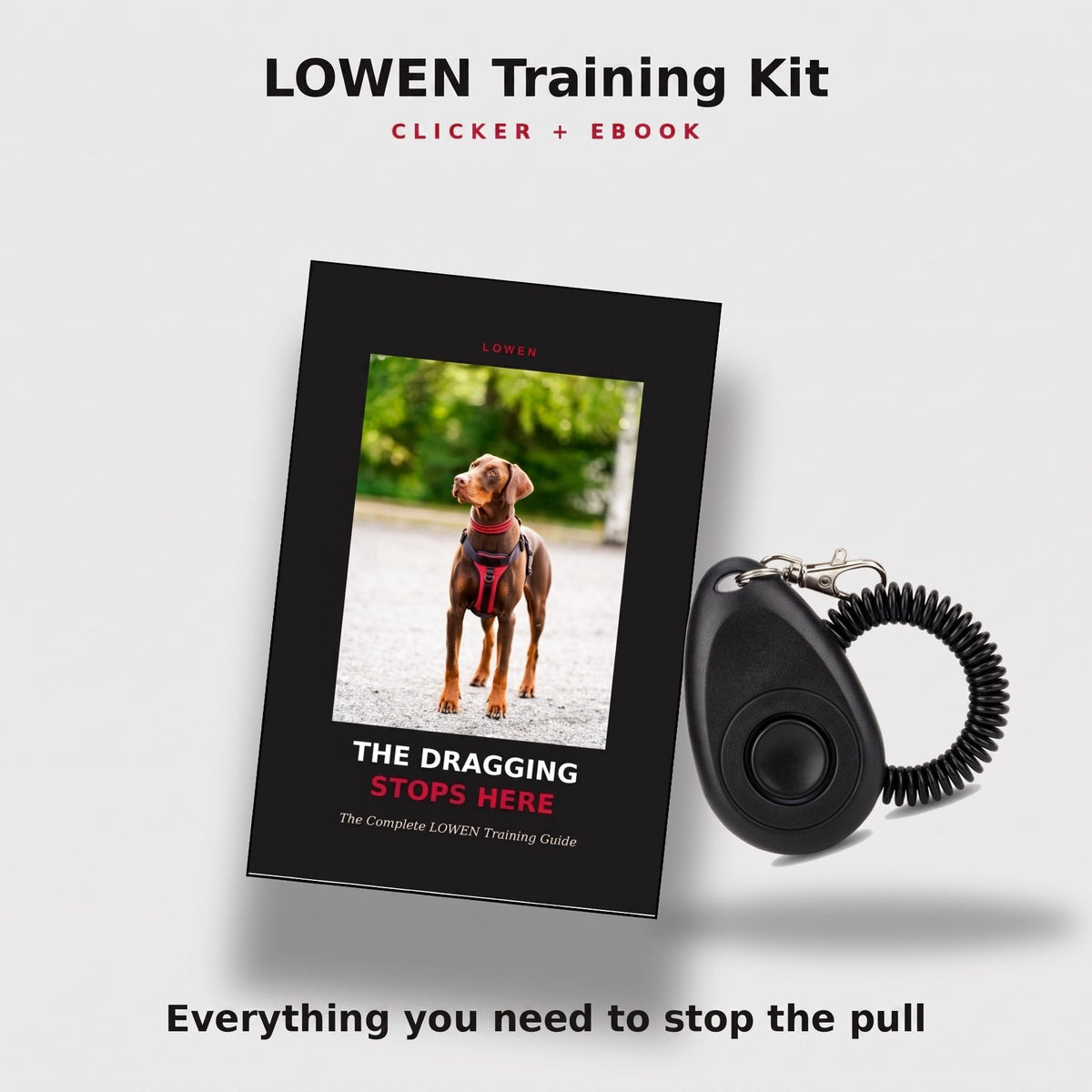
LOWEN Training Kit — Clicker + Complete Training Guide
Couldn't load pickup availability

- 5 stars: 42 (89%)
- 4 stars: 5 (11%)
- 3 stars: 0 (0%)
- 2 stars: 0 (0%)
- 1 star: 0 (0%)
At the beginning, Theo could only take two loose steps in our hallway before surging ahead. Instead of calling the whole session a failure, the guide helped me reward those two steps and build from there. He can now manage most of our quiet block with intermittent rewards. Busy intersections are still difficult, but the improvement is specific and obvious.
The clicker is physically simple, but using it correctly changed how precise my feedback is. My dog no longer has to guess which action earned the treat.
Not every outing needs to be one long lesson. We now do a focused practice block, then let our dog sniff and decompress.
The clicker itself works well, but the coiled strap feels tight over my winter gloves. I clip it to a pocket loop when the weather is cold.
My spaniel still notices birds, but she returns her attention more quickly when I mark the first glance back at me. That response took repetition, not one session.
Once my dog was successful indoors, we moved to the front yard. The guide helped me increase difficulty without jumping straight to a crowded park.
Both my partner and I produce the same marker sound now. Our verbal praise used to vary so much that the dog often seemed unsure.
We have also used the clicker for place, touch, and waiting at the food bowl. The same timing principles transfer easily.
We had tried stopping, turning, and changing harnesses, but I applied each idea inconsistently and abandoned it after a few days. This kit gave me one marker and a clear progression. I started recording five-minute sessions so I could see whether we were actually improving. That made a difference: our dog now reconnects with me faster after noticing a distraction.
The guide does not pretend one piece of equipment will erase a habit. It breaks the walk into trainable choices and gives the owner a role.
We keep practice short and finish before she loses interest. She gets excited when the clicker comes out because it predicts a chance to earn rewards.
The sound is quick and consistent, which is useful when my dog only gives me one second of the behavior I want.
I now have clear criteria for when to click, when to reward, and when the environment is too difficult. Our sessions are much more deliberate.
The information is practical, but I personally prefer a printed booklet that I can mark up. I printed the key pages and use them that way.
I click when my dog chooses to settle while I put on the harness. Our pre-walk routine has become noticeably less frantic.
The first week did not look impressive. We practiced attention in the kitchen and only walked a few steps at a time in the driveway. By week three, my boxer could give me short stretches of loose leash on our quiet street. We are not finished, especially around other dogs, but I finally understand how to progress without simply pulling him backward.
My beagle understood the click-and-treat connection almost immediately. The challenge is still competing with smells outside, but the guide addresses gradual distractions.
When my dog pulled, I used to become frustrated and tighten the leash. Following a planned exercise gives me something constructive to do instead.
I keep the ebook on my phone and review the next exercise before going outside. The sections are manageable enough to use as a reference.
I click whenever Otis voluntarily looks back at me on a quiet walk. He now offers that behavior more often before reaching the end of the leash.
The guide explains the purpose of the click rather than treating it like a magic button. That distinction prevented a lot of confusion.
A full walk can still be messy, but I now notice individual good choices and mark them immediately. Those small wins are starting to add up.
The kit is well organized and the clicker is convenient, but much of the guide was familiar to me after several group classes. Better suited to beginners.
Nora shut down when we used leash corrections, so I wanted a reward-based way to teach her what to do instead. We began inside, clicking for attention and a loose leash, then moved to the yard. She is still cautious in busy places, but training no longer feels like a confrontation. That has been the most important improvement for us.
My teenagers now know exactly what behavior earns the click. The dog receives much more consistent feedback regardless of who holds the leash.
I was increasing distractions before my dog understood the exercise in a quiet room. The guide helped me slow down and build the behavior in stages.
The coiled wrist strap is better than a loose clicker. I can release it to handle the leash and it remains within reach.
Our nine-month-old golden gets distracted by everything. The exercises gave us realistic steps rather than expecting a perfect heel on day one.
I was talking constantly and my dog had learned to ignore half of it. The clicker helped me communicate with less noise and better timing.
The guide encouraged us to practice attention and position indoors first. Starting somewhere quiet made outdoor sessions less frustrating.
Once the click was paired with treats, my terrier understood the marker fast. It makes capturing a brief moment of calm much easier.
The written steps are useful and the clicker works well, but I would have liked more visual examples of leash position and handler movement.